
People usually make dumbbell buying more complicated than it needs to be.
The question is rarely, “What is the best dumbbell in the world?” It is usually much simpler than that.
“What weight should I buy?”
That is the real question.
And the honest answer is: buy the weight you can actually use properly, not the weight you wish you could lift.
That sounds obvious, but it is where a lot of people go wrong. They either buy dumbbells that are far too light and outgrow them in a few weeks, or they buy a heavy pair that looks great in the corner but barely gets lifted.
For home training, dumbbells have to be practical. They need to suit your space, your strength level and the type of workouts you are actually going to do. A pair that works well for squats might be too heavy for shoulder exercises. A pair that feels perfect for curls might be too light for legs and back.
So before choosing the weight, think about the exercises.
If you want dumbbells for curls, shoulder press, light toning work and general movement, you will not need the same weight as someone doing rows, lunges, Romanian deadlifts and loaded carries. Your lower body and back can usually handle more weight than your arms and shoulders.
That is why one pair can get you started, but it may not cover everything forever.
For a lot of home users, that is fine. Start with one useful pair. Train with it. See what you actually use. Then add more weight when the need is real.
A pair of 7.5 kg dumbbells is a good example. For many people, 7.5kg sits in a nice middle ground. It is not a tiny warm-up weight, but it is not frighteningly heavy either.
You can use 7.5kg dumbbells for curls, rows, lunges, shoulder press, goblet squats, Romanian deadlifts and home circuits. If you are new to training, they may feel challenging enough. If you have trained before, they may become your lighter pair for higher-rep work or quicker sessions.
That does not make them useless. In a proper home setup, lighter dumbbells still get used. You do not throw them away just because you get stronger. They are useful for warm-ups, shoulders, controlled movements and days when you want a quicker workout without going too heavy.
Then there is the next step up.
Once 7.5kg starts feeling too easy for rows, squats or lunges, you may need 10kg, 12.5kg or heavier. But there is no rush. Moving up only makes sense if your form stays clean.
If the dumbbell is pulling you out of position, making you swing, or forcing you to cut the movement short, it is too heavy for that exercise. You might lift it, but you are not really training well with it.
A clean set with a moderate weight is better than a messy set with a heavy one.
For stronger home users, 22.5kg dumbbells are where things become more serious. A 20kg dumbbell is useful for rows, goblet squats, Romanian deadlifts, lunges, floor press and farmer’s carries. It is especially good for back and leg work, where lighter weights often stop feeling enough after a while.
But 20kg is not a beginner weight for most people. You should be able to pick it up safely, control it through the movement and put it down properly. If you cannot do that yet, build up first. There is no shame in that. Strength training is supposed to progress.
The type of dumbbell matters too.
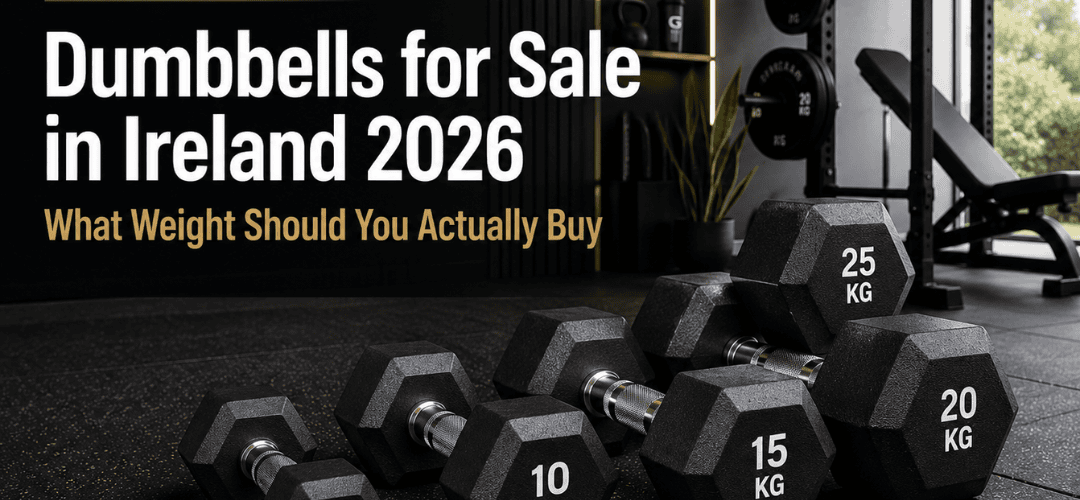
For home gyms, hex dumbbells are usually the easiest choice. The flat sides stop them rolling across the floor, which is more important than people think. In a sitting room, spare bedroom, garage or garden room, you do not want round dumbbells moving around after every set.
Hex dumbbells are also better for floor work. If you are doing plank rows, renegade rows or press-up style exercises, they feel more stable than round dumbbells.
They are not fancy. They are just practical. And for home training, practical wins.
Then comes the bigger decision: one pair or a dumbbell set with rack?
If you are only starting, one pair is enough. There is no point buying a full setup before you know you are going to train regularly. Start with a pair you can use for several exercises and build the habit first.
But if you already train, or if more than one person in the house will use them, a dumbbell set with rack makes far more sense.
Different exercises need different weights. You may want lighter dumbbells for shoulders, medium weights for presses and curls, and heavier dumbbells for rows, deadlifts and squats. Trying to use the same pair for everything gets annoying after a while.
The rack matters as well. Loose dumbbells on the floor make a room untidy very quickly. They also become a trip hazard, especially in a busy home. A rack keeps everything in one place and makes the setup feel more like a proper training area.
That is useful in Irish homes, because most people are not building a perfect gym room. They are training in whatever space they have — a garage, spare room, box room, sitting room corner or garden office.
Dumbbells work well because they do not need much space. One pair can sit neatly in a corner. Several pairs can sit on a compact rack. You do not need to take over the house.
The important thing is to keep them easy to reach. If your dumbbells are buried away somewhere awkward, you will use them less. If they are visible and ready to go, a 20-minute workout becomes much easier to start.
For fat loss, dumbbells are useful because they let you train more of the body without needing machines. Squats, rows, presses, lunges, deadlifts and carries can all be done at home. Put a few of those together and you have a proper session.
You do not need the heaviest pair for that. You need a weight that lets you keep moving while still feeling challenged. Too light, and the session feels like a warm-up. Too heavy, and you keep stopping because the form falls apart.
For muscle building, the answer is different. You need room to progress. One pair can start the process, but over time you will probably want more weight. That might mean adding 10kg, 12.5kg, 15kg or 20kg dumbbells as your strength improves.
A small range of dumbbells makes training much easier. You are not forcing one pair to do every job. You can choose the right weight for the exercise.
That is how home workouts start feeling like proper strength training.
If you are looking for dumbbells for sale in Ireland, Gymgear.ie stocks a practical range of dumbbells for home training, including individual dumbbell pairs, hex dumbbells and dumbbell sets with racks.
For beginners, 7.5kg dumbbells can be a sensible starting point. For regular training, 10kg, 12.5kg and heavier options give you more room to grow. For stronger users, 20kg dumbbells can be a very useful addition to a home gym.
The best dumbbells are not always the heaviest ones.
They are the ones you actually pick up and use.
Start with a weight you can control. Add more when your training needs it. Keep the setup simple, tidy and easy to access. That is usually enough to turn a pair of dumbbells into one of the most useful pieces of home gym equipment you own.
